
A while back I did a video tutorial for Foundation Single Crochet (FSC), which shared my method for making that stitch. Now to complete the job, I've made one for Foundation Double Crochet, usually abbreviated as FDC!
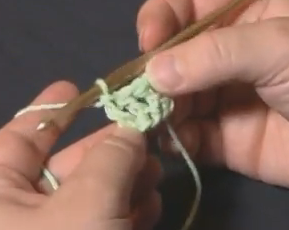
Foundation Double Crochet Tutorial
How to Crochet the Foundation Double Crochet Stitch - Right Handed
How to Crochet the Foundation Double Crochet Stitch - Left Handed
Written Instructions for Foundation Double Crochet:
The First FDC Stitch: Ch 3. Yo and insert hook into the chain furthest from the hook, yo, and pull up a loop. Yo and pull through the first loop on the hook. This acts as the starting ch for this stitch. Yo and pull through two loops, yo and pull through the last two loops on the hoop, as when making a dc stitch. This completes the first FDC.
Subsequent FDC Stitches: Yo and insert hook into the V at the bottom of the previous stitch. Yo and pull up a loop, then yo and pull through the first loop on the hook. Yo and pull through two loops, yo and pull through the last two loops on the hoop, as when making a dc stitch.
This stitch is great for all the same reasons that FSC is great:
- No counting tiny chains to make sure you have the right number - just count your nice big stitches!
- When you are starting a new project and don't have an exact stitch count, you can work to the width you want without having to frog a bunch of stitches to get the right ch count.
- No working into the chain stitches, except for that very first stitch! No picking and poking, and no twisting the chain either.
- This is also a great alternative for those who have trouble with making their chains too tight or too loose. Once you've got the hang of it, these "chains" are always at your usual stitch gauge.
- It creates a far stretchier edge than a chained edge, which is very desirable for garments in particular. And it looks really great, very polished.
- Lastly, since it counts as the chain row AND the first row of dc, it's a time saver, getting you to the fun part faster! Once you've finished a row of Foundation Double Crochet Stitches, you just go on to the second row of your project as written.
I hope this has made it all clear for you! FDC is one of my favorite ways to start a project, especially when I don't know how many stitches I'm going to need. Or when I making a neckline or cuff, or....
Thanks again for watching, and if you have any questions, comments, or ideas for videos you'd like to see, please let me know in the comments!

Be sure to check out and like the moogly Facebook page to get the latest updates, links, and sneak peeks! Moogly is also on Pinterest, Twitter, and Tumblr – come join the fun! You can contact me via Facebook messages or at TamaraKelly@mooglyblog.com.


Michaele R. Wilkins
I Love To Learn New Stitches and Patterns Also.
Jenny B
I just love this concept and I thank you for posting these video tutorials. I have a scarf pattern that I created and doing a Foundation Half Double Crochet makes the pattern work up much easier. I am hoping to sell my pattern on Craftsy.com and I would like to ask permission to send my customers to your website for the tutorial on this stitch. Thank you for your help! -Hooked by Jenny
moogly
Jenny, that would be great! Thanks so much!(and you are very welcome!)
Angel
Hi,
When using FDC in a project with written pattern directions that call for a chain first, do I just ignore the chains I made at the beginning of FDC or do those chains count as my first dc as they do with most patterns.
When I watch your video and you count at the end, 3 FDC, there looks like 4 stitches, because of the first chains. Would those chains count as the first dc when I work my next row?
Thank you for all the work you do teaching.
Angel
moogly
Angel I would just follow the directions from the pattern and use whatever looks best in what you're making. If the pattern uses the first few chains as a dc you could do that here too, or you might find that skipping it and working into the FDC looks better - there's no hard and fast answers I'm afraid! I know that sounds like it's frustrating, but think of it as liberating - you can always do what you think looks best, and it's never "wrong"!
Jennifer
I this is a little confusing to me too. What did you end up doing?
Angel
I did use the chains as the first DC. With my particular pattern, once the first row is made it is worked in the round. When my first round was worked it covered that chain and the last FDC.
Angel
I will try it both ways.
I have restarted my very long FDC several times this morning. I was having trouble with it wanting to twist, because the side that acts as the chain side had much more tension. After the forth start I tried pulling the loop that acts as the chain up a good bit before finishing with the dc. Now I have a flat FDC, but very stretchy.
Do you foresee any problems with that? I am doing a mile a minute pattern and the FDC is the center of each strip.
moogly
I haven't done any mile a minute patterns myself, so it's hard for me to say for sure, but I can't imagine it would cause trouble? It's definitely a very stretchy stitch!
Spacey
Thank you for making this comment! I had the same problem and your post helped a lot.
Nicole
This has changed my life!!! I had never heard of this before and the worst part of crocheting for me is not so much making the chain but how long it takes for me to complete the first row. Thanks for the tutorial!
moogly
You're very welcome Nicole! 😀 It's a great technique - and one of the best things is the amount of stretch you get with it!
Patti
Love the technique!
I am currently working on a scarf that calls for
DC, DC, CH 10, Skip 10 DC, DC,DC (4 times)
I get the FDC but how do I then go on to chain the next 10?
Or is it best to just do it the old fashioned way?
Thanks
moogly
Thanks Patti! If the first row (after the chain) is what you typed out, then I don't think fdc will work for you, unfortunately. It works best if the entire Row 1 of the pattern is a row of dc worked into the chains. I can't think how you'd do this though, I'm sorry. One thing you could do is work as many FSC as you are supposed to make chains (minus the chains that give you the first dc or get you to the height for it). It will give you a more solid edge than a simple chain, but without seeing the pattern it's hard for me to tell if that would be good or bad.
Ruth
I love your tutorials, so clear and concise 🙂
Tamara Kelly
Thank you so much, Ruth!
Cara Louise
I always love finding just what I need on your site, thank you! I just linked up this video in my blog post- http://carascrochet.weebly.com/1/post/2013/06/fdc-foundationdoublecrochet-and-fantasticdesigncomponent.html
Tamara Kelly
Love it Cara - thank you so much for your kind words!
Michelle
Just wondering if I'd be able to use this if the first row contains increases and decreases? Is there anyway to do increases and decrease in a fdc?
Tamara Kelly
It's easy to increase - just work a "regular" dc in the same base chain part as the previous fdc. For decreasing, when working the base chain, work the appropriate number of "extra" chains before starting the next actual fdc. I hope that makes sense!
Sara b
Hi. I just fell over this site and is hoping you're still up and running. I have a pattern saying to do a FDC increase, and I looked everywhere but can't find a video. I'm more visual ... Is it possible for you to do a video on it?
Tamara Kelly
Hi Sara! Definitely still going strong. 🙂 I can think of at least two ways to increase with FDC, but my best guess is that they mean that you should work the first of two fdc sts normally, then going into the bottom as you normally would, work a standard dc instead of an FDC. Then go into that same bottom stitch again and continue as you normally would. That's just a guess based on what you said though!
Ruby
Thank you Tamara, for sharing. I am glad I found your blog. Your tutorials and videos have helped me to refine my crochet skills. Looking forward for more great things from you.
Tamara Kelly
😀 Thank you so much Ruby!
Diana
Thank you so much! I not only like the idea of bypassing a row of chain stiches but the "stretchiness" of the edge! I think this will work very well arm & leg warmers I'm wanting to make for Christmas gifts. I found your page on Facebook & then your site, had no idea there was anything this helpful out there.
Thank you again.
Tamara Kelly
😀 Thank you Diana! I'm glad you like it - it's great anywhere you need more stretch!
Penny
I learn so much from you. Thanks for this tutorial. It is awesome! I just started your Cuddly Cat Scoodie for a Christmas gift. And, I learned a new stitch from you. This FDC is gonna save me time on future patterns, too. Thank you!
Tamara Kelly
😀 You're very welcome Penny! It can be a huge time saver indeed!
Jody
Were has this been all my life?! Fantastic, thank you so much for the tutorial!
Meegan
Trying, trying...my bottom is wonky. Is there any chance that you could post a picture when you're about 10 stitches in? My head wants my work to be horizontal while I'm making the FDC, but the work is hanging down. I'd love to see a close up of a good start of this, with at least 10 FDC's made. I am attempting the Eloise Sweater, and it's never a good sign when step one flummoxes me.
Tamara Kelly
Hi Meegan - do you mean that the first row is curved, with the ends pointing down? This happens when the first chain of each stitch is a little too tight. When you make the FDC, make sure that the first chain of each stitch - the one that represents the foundation chain - is pulled up a bit higher or larger than normal. Additionally, a very slight curve will be straightened out when you work the second row.
Meegan
Oh, ok. Will make that correction on the foundation chain part. I wasn't finding the "V", but I practiced like a crazy woman and have the hang of it...at least it doesn't look like popcorn anymore, lol! Started my sweater...boy this is quicker than knitting!
Thank you very much! 🙂
Clotilde/Craftybegonia
Very nice tutorial! I always love to learn new ways of doing crochet, thanks for sharing!
Tamara Kelly
Thank you! 😀
BARB
Moogly has come through for me again! I tried several sites and couldn't figure them out. Your written instructions are very clear and easy to follow. Keep up the great work- I appreciate you!
Tamara Kelly
😀 Thank you so very much Barb!
Christine
Thanks for the great tutorial. After all my years crocheting, I learned something new today!
Mary
When making a certain number of Foundation Double Crochets, do you count the beginning ch 3? In the tutorial video, you did not. I'm am wondering how to handle this in the Eloise Baby Sweater because the instructions don't mention it. Thanks for your help!
Tamara Kelly
Some people do, but personally I do not. In the Eloise Baby Sweater they do not count. 🙂
Julie
Thank you!
MARY baribeau
Maggie,
I have a question on your pattern Sweater for Girls, it says to chain 43 then to do Foundation Double Crochet. This is confusing to me. Which do I do? I am making this for one of the little girls at my church. I've made 2 from different patterns but I wanted to switch up patterns. I would appreciate your response to this. I'm learning new stitches as I do crochet. This is a new stitch. I've learned how to do a half double crochet chainless foundation. I love learning new stitches. Thank you on advance for your help. I really love your patterns.
Tamara Kelly
Hi Mary! The Eloise Girls Sweater doesn't include directions to chain. Perhaps you're reading the stitch count at the end?
Sherre twigg
Tamara, I just found your page this morning and have abandoned my latest John Grisham book (my original plan for the morning) because I watched one of your tutorials and then another and then, well.....here I am an hour and a half later. Your instructions are so clear, and your tutorial videos are easy to follow. I can't wait to try some of the new stitches. My mother taught me to crochet 30 years ago and I've made some nice things, but this time spent on your site got me excited again about crochet. Well, maybe it's a combination of your instructions and my brand new two week old granddaughter to make beautiful things for. Thank you SO much!
Tamara Kelly
Oh my gosh, thank you so much Sherre! 😀 And congratulations on your new granddaughter!!
Shannah
How would you join a foundationless chain to make an infinity scarf? I like the look and stretchiness of a foundationaless chain, but have not been able to figure out how to seamlessly join the beginning and end of the chain to work in the round. You can't just use a slip stitch, as it only joins the top of the chain. I'm sure someone has likely figured this out, I just haven't been able to find a tutorial.
Thanks,
Shannah
Tamara Kelly
Ah, great question - and I have just the tutorial for it! 😀 Click here
Andra
This is an amazing stitch! I can hardly wait to try it! Thank you for your video to share it with us!! Hugs from here... 🙂
Tamara Kelly
Thank you Andra!
Sharon b
Tamara - you're amazing! I am just now tackling foundation stitches after re-starting to crochet this past fall (after a 15 yr break). I read book instructions, a couple of sites & watched another video on this but it wasn't until YOUR video that the one part that was confusing me them most (what loops of the chains to work under) was made clear. THANK YOU! I usually work under the back bump of starting chains too, all the sites would refer to the "ch" created in FDC but no one would talk about all the different loops as clearly as you do. I have been a fan of your designs & blog since I started crocheting again, you have really helped me get up to speed technique-wise! Just added you as a fave designer of mine on Ravelry (what took me so long??). Much appreciation & keep up the excellent work!
Tamara Kelly
Wow, thank you so much Sharon! I have to admit, foundation stitches always confused me too until one day it "clicked" for me what all the parts were doing! 😀
isabrode
Thank you from France 🙂
Jo
Thanks! Your instructions are clear and concise.
Tamara Kelly
Thank you Jo!
Angela
I am so grateful for your blog. I learned to crochet watching YouTube videos, and your blog has done WONDERS in teaching me so much about fun stitches and patterns! This is an AWESOME blog ::-). And your foundation stitches have completely cuhanged the way I crochet!
Tamara Kelly
Wow, thank you so much Angela!! ♥
mere
I only recently realized you had your Eloise sweater in girls' sizes, after a long time wishing I'd found the baby version in time to make for my niece. (I'm slowbrained sometimes.)
I'd like to do skirt in linked double crochet because I love the way it looks and the more solid fabric it creates. I'm wondering if it's possible to do foundation linked double crochet, because otherwise, the foundation row being unlinked while the rest is linked will really bother me. Of course, I'm doing this wondering when I have no yarn or hooks at hand for trial and error.
Should it be possible to work the fdc as usual, except after the YO pull through one loop to make the chain part, go through the previous stitch instead of a YO to start the double crochet part?
Tamara Kelly
Hi mere! You can absolutely combine FDC and Linked stitch - just do the "go through the bar" rather than the yarn over to start each new fdc. 🙂
mere
Thanks! I will have to give it a try once I'm home.
Sarah
I tried to watch the video but there was not one for the foundation double crochet and I just cannot figure out how to do it. What happen to your nice video I read so much about? Please could you post another one. Thank you so much.
Tamara Kelly
I'm sorry, I'm not sure what you mean - it's right here on the page. If it's not loading up for you, maybe going directly to youtube will help: https://youtu.be/y__JXaQU8F0 🙂
Arlene Green
Tamara, I'm working on a top that is done in rounds - and the base chain is 288 stitches. After trying twice to stop from twisting on the first DC row, I remembered your FDC tutorial - I'm now about to start my fourth row, all nice and straight because you helped!
Thanks so much for this! Arlene Green
Tamara Kelly
😀 That is indeed a long one!! I'm so glad it helped!
Cathy S
I love using the foundation row, whether it's single or double or whatever, and it's made my crochet life much easier.
I have a pattern that starts with a base chain, and requires double crochets for the first five stitches, then skip two stitches and put in two chains to replace them. Single crochet in the next chain, then chain two-skip two again. This pattern repeats across the first regular row.
How can I switch to a no-chain foundation, but maintain the pattern? I'm at a loss as to how to accomplish this technique, but still keep the design. Please help!
Tamara Kelly
Hi Cathy! Sometimes foundation chains just won't work for a first row. I can increase and decrease, but creating chains at both the top and bottom while using foundation stitches isn't possible, as far as I know. I'd love to find out I'm wrong though!
sharon perkins
son of a biscuit! That's so easy!!! of course I'm going to watch it again with hook in hand so i can do the Moroccan market tote 😀
thanks!! merci, gracias, danke!!!
Tamara Kelly
😀 Glad it helped!
simona
Hello Tamara,I'm pretty new to the crochet and I'm working on my first "big" project (for me at least). The pattern says: " work additional 60 fdc " The work is already began and I have already worked 60 dc in this row that is the 25 th. I have learned how to do the fdc thanks to your tutorial, but I don't understand where I have to start the new fdc, if at the top of the last d.c. ( and so I will have like a step in my work and it seems weird to me) or at the bottom the last d.c., that makes more sense but isn't specified and I'm not sure how to put the yarn there. There is a right way to do it? Thank very much,
Simona
Tamara Kelly
Hi Simona! Without seeing the pattern I can't say 100%, but it sounds like they want you to do this: https://www.mooglyblog.com/extending-rows-fsc/ but of course with double crochet sts, not sc. 🙂 Does that work?
Simona
Oh yes!!! Now I have understood what I have to do!!!! Thank you so much!!
Tamara Kelly
Oh good, I'm so glad! 🙂 Thank you!
Barbara
World domination? I think you are there with this mind bending but simple solution to the heart break of a tight edge from the original chain!!! My allegiance is yours.
Tamara Kelly
😀 I'm so glad you like it Barbara! Thank you! (And mwahahahahahahah!)
Kathi
Ok, this I definitely need to see a left handed version of! This almost seems too good to be true and it's what we've all been waiting for and never thought of. I am having problems trying to mirror image it though, so could you show left handed video, perhaps?
Tamara Kelly
Oh wow, we made this so long ago I wasn't doing left handed vids yet, and I didn't realize we never came back to it! I'll add that to the to-do list, thank you Kathi!
Kat Williamson
I too would be interested in a lefty vid. The written instructions sound workable, but it's definitely nice to have visual backup!
Tamara Kelly
It's on my to-do list for sure! I'm still surprised I missed it so long!
Sarah
Well, this was so much easier than I was expecting. Thank you so much for you easy to follow instructions and awesome tutiorial videos, I am so excited to try the ear warmers pattern.
Sarah
Tamara Kelly
😀 I'm so glad to hear it! Thank you Sarah!
Sarah Skilton
I make crochet fingerless mitts to where I have to start with a 40ch ss into first chain to make a circle, then treble (uk) into each chain. So could I do this instead to start my mitts I always make the chain too tight and struggle to get the hook through or miss a chain or twist the round.
This makes the starting round so much easier. Thank you so much.
Sarah
Tamara Kelly
Hi Sarah! Yes, I love this stitch for cuffs, hat brims - anything where you want stretch and don't want a tight chain! 🙂 I hope you enjoy using it!
Melissa Hungria
I so appreciate you doing this! I am a newbie crocheter, and while I understand the double-crochet, when I saw the FDC in a recently purchased pattern, I had no idea what the pattern was referring to. This tutorial helped me so much and while it is a bit wonky in parts, you're right - it's a bit more stretchy which is necessary when a pattern calls for a chain stitch as the foundation. Happy to find your site and I'll be visiting again. Thanks again!
Tamara Kelly
😀 Thank you so much Melissa! Have a wonderful new year!
Marilyn Culp
Hi Tamara. I am trying to learn how to do the foundation double crochet and am having trouble with it curving. I am working on a test swatch right now in preparation for making a cape and hope it won't be a problem. Any suggestions on how to stop that happening? Thanks in advance for your help.
Marilyn
Tamara Kelly
Hi Marilyn! This happens when the first loop - the one that makes the chain - it a little too tight. Try pulling that loop up a little bigger than the rest. 🙂
Marilyn Culp
Thanks Tamara for your reply. Practice makes perfect eh lol
Happy hooking,
Marilyn
Tamara Kelly
Indeed! 😀 And I meant to add before, a very slight bend isn't usually an issue at all - it will straighten out fine as additional rows are added. 🙂
Bessie Alcantra
Your written instructions are very clear and helped me get the stitches in place, more so than when I watched some videos which leave me in doubt. I have no projects in mind yet, just want to get this basic right. Great job, and thanks!
Tamara Kelly
Thank you so much Bessie, I'm so glad to hear it! ♥
Lynnette
Can a fdc be used when crocheting a chevron blanket? Ifso, where can I go d instructions?
Tamara Kelly
Possibly, depending on the pattern! Here's how to do it: https://www.mooglyblog.com/increasing-decreasing-foundation-stitches/ 🙂
Lorrie Hale
As a left-handed person, I really appreciate you taking the time to make the videos left-handed as well! thank you. I am brand new at crocheting, and not having to tax myself to "mirror" a description is wonderful.
Tamara Kelly
♥ Thank you so much Lorrie, I'm so glad it's helpful!
Pam
How do you adjust the repeat when you use the FDC? I am making a baby blanket that has repeat of 28 plus 11. First row is double crochet, then the second row starts the pattern with DC in 4th chain from hook. I'm basically eliminating chaining into the 4th chain from the hook by using the FDC, but I'm not sure how many stitches to make across. I hope this makes some sense.
Tamara Kelly
Hi Pam! It sounds like the pattern you are following counts the 3 skipped chains as a double crochet. So you would make as many FDC as the number of chains the instructions start Row 1 with, minus 2. Does that make sense?
Pam
Yes it does make sense, thank you so much!
Cindy Pye
I was really intimidated about learning this stitch, but you made this very easy to learn and to do. Thank you!
Tamara Kelly
I'm so glad to hear it! Thank you, Cindy!
tricia
sadly, my brain is not getting this. if i want to make something with fdc, do i just add 3 to a beginning chain?
Tamara Kelly
I'm not sure which direction you're trying to go, so...
If the pattern calls for chs that you work dc into for the first row, then you just FDC whatever the final st count is for Row 1.
If the pattern calls for FDC, and you prefer to chain, you have a couple options:
A - ch 2 more than the number of FDC called for, and skip the first 3 chains and count those as your first dc, and dc in each rem ch across.
B - ch 2 more than the number of FDC called for, and skip the first 2 chains, and do NOT count those as your first dc, and dc in each rem ch across.
As long as your final st count is the same, the rest is up to you!
Erica
My goodness, this is so much better than starting with a chain! I can _never_ get the tension right on a starting chain - or at least not once I start chrocheting into it with the next row. This solves the problem neatly. Thanks!
Tamara Kelly
I hope you enjoy using it, I always start with foundation sts when I can! 🙂
Lena Patterson
I am currently making a hat for my niece shes turning 8 next week.. was wondering instead of buttons on the side can i use a pretty hair bow.. im making a large and i know its gonna be big but i got to thinking she will eventually grow into it and i can fold the hat to fit and add the hair bow as a fastener and just a pretty item to the hat..
Tamara Kelly
I think that sounds lovely! ♥