
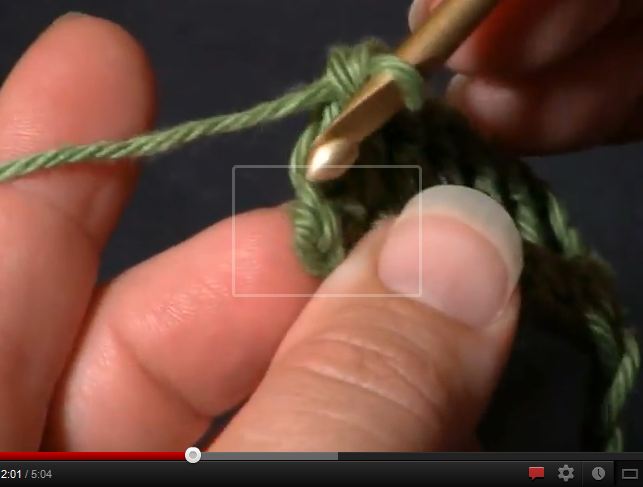
To crochet or not to crochet? When it comes to turning chains, the answer isn't always clear. Sometimes a turning chain is not just a turning chain - it can be a whole stitch! It all depends on the pattern you're using, but 9 times out of 10, the "rules" are the same - make the same number of chains as you have in the height of the next stitch. In other words, ch 1 for a sc row, ch 2 for a hdc row, ch 3 for a dc row, etc. This video should help explain a bit more.
There are always exceptions to the rule, of course. And being familiar with your own gauge means you can bend those rules and patterns to work with your own style. Some find that a ch 2 creates all the height they need for a dc row, while others stick with the traditional ch 3 - and the patterns they write will reflect their own personal tension. Don't be afraid to play around and see what works best for you, and what look you like best, regardless of what the pattern calls for. The key is to only count the turning chains as stitches that are being used as stitches.
I hope this video has helped you understand a bit more about the hows and whys of turning chains! There's a pattern to it all, but the "rules" of crochet are really more like guidelines - never be afraid to do what works best for you, or what you think looks better. There are no crochet police, and as long as you are getting the results you want, you're doing it right.
Once again, thanks for watching! And let me know if there are any videos, stitch tutorials, or questions you'd like to see me answer - I love to read your comments!

 Be sure to check out and like the moogly Facebook page to get the latest updates, links, sneak peeks, and more! Moogly is also on Pinterest, Twitter, and Tumblr – come join the fun! You can contact me me via the Facebook page or at TamaraKelly@mooglyblog.com.

Andria
This is very helpful! I'm still a beginner with crochet, and this clears up a lot of confusion I've had. Thank you!
moogly
Oh good - that's exactly what I was hoping to do! Thanks so much for saying so, Andria! 😀
Doreen
I would like to learn to crochet the shell stitch. I am a beginner, I have the other basic stitches, now I would like to learn the shell stitch.
Thank you
Doreen
Tamara Kelly
Ah, good one! I'll add it to the to do list! Thank you!
Cherry Ivey
I am going to crochet your Moroccan Tile Afghan. In the beginning instructions it states in the NOTE "You will work 2 rows, first Color A (odd rows), then Color B (even rows), going in the same direction, before turning your work and starting again with Color A and then Color B." Also, at the end of Row 1 it states Do not turn. How do I do this. How do I go on to Row 2 without turning?
Tamara Kelly
Yes! Row 2 is crocheted in the same direction as Row 1, right on top. I'm planning a video tutorial and photo tutorial for next week - I know this is a complicated pattern to understand from just the words. 🙂
Nancy Pilgrim
The video did not pull up for the tutorial on All about turning chains.
Tamara Kelly
Thank you so much for letting me know, Nancy! It's all fixed now 🙂
Nancy
Thank you so much for getting the video up about "All about turning chains.
It is a great help to me. I was having a little trouble with my turning chains, but
the video showed me exactly what I needed to know.
Tamara Kelly
I'm so glad to hear it, thank you Nancy!
Colleen Roberts
My concern is do I turn clockwise or counterclockwise when turning my work. I’ve seen it being done both ways and not sure if there’s a reason for going either way. By the way I love your tutorials and have suggested them to several friends. Thank you Tamera for your help.
Tamara Kelly
I prefer to turn clockwise, as a right handed person. If I were left handed, I suspect I would turn counterclockwise. The most important thing though is to be consistent throughout the project. Try a few rows each ways as an experiment, and see which you think looks best! 🙂 Thank you so much! ♥
Marlene
Thank you so much for your video explaining this "turning" thing. I am trying to learn to crochet and I can't seem to figure out what to do or how to do a turning chain. My trouble is where do I enter the hook after turning when going into a turning chain and when to have this turning chain. I do believe I got it now that I listened to your explanation. Your help his greatly appreciated. Thank you!
Tamara Kelly
I'm so glad it helped! It's definitely a nuanced topic!